From the waters of the Potomac River and the city of Alexandria down to the coastal ports of Norfolk, then heading west to the state border, every resident of Virginia would be impacted by NextEra Energy’s proposed $66.8 billion acquisition of Richmond-based Dominion Energy if the deal receives final regulatory approval. The Energy Commission of Virginia met June 9 to address, among other items on its agenda, that specific proposal.
The political responsibility of tracking that massive statewide impact falls squarely on a 14-member legislative panel dominated by local Northern Virginia leadership, including Commission Chairman Sen. Scott Surovell (D-Fairfax), House Majority Leader Charniele L. Herring (D-Alexandria), Del. Irene Shin (D-Fairfax) and Del. Richard C. "Rip" Sullivan Jr. (D-McLean).
Members of the commission warned that a compressed statutory review window could force the state to greenlight the acquisition before legislative safeguards can be enacted. The legislative panel, which is scheduled to be renamed the Energy Commission of Virginia on July 1, is closely tracking the deal's timeline. According to virginiageneralassembly.gov, “The purpose of the Commission is to monitor the State Corporation Commission's implementation of the Virginia Electric Utility Regulation Act.”
Staff attorney Sarah Kinzer clarified the timeline under the Utility Transfers Act, explaining that the State Corporation Commission has 60 days to act on a petition and may extend that period by up to 120 days, for a total possible timeframe of 180 days. Surovell warned that the regulatory process will likely wrap up before the General Assembly can convene to write defensive standards.
“This is probably some of the biggest utility news this state has seen in decades,” Surovell said.
Local experts and interested parties, including Bernie Gilmore of Clean Virginia, agreed that this window is too short to evaluate a merger that would create a combined market capitalization of nearly $250 billion and 110 gigawatts of generation capacity. Commission on Electric Utility Regulation Executive Director Carrie Hearne designated the acquisition as the commission's top priority to explore how lawmakers can ensure the deal "does not harm the state’s ratepayers, regulatory independence or clean energy commitments."
Fast Clock and Narrow Legal Test
Staff attorney Sarah Kinzer briefed members on the Virginia Utility Transfers Act, noting that the State Corporation Commission's review is narrow. The statutory standard for review is whether “adequate service to the public at just and reasonable rates will be impaired or jeopardized.” South Carolina has a similar standard, which Kinzer contrasted with North Carolina and Maryland, which apply a “public convenience and necessity” standard that includes additional factors such as benefits and no harm.
Shin emphasized the urgency. “I’ve heard from a lot of my constituents about concerns in this acquisition, and I think it’s incumbent upon us to make sure we are protecting ratepayers through this process,” Shin said.
Utility Expert: Timeline Is 'Not Possible'
Public-interest utility expert Scott Hempling criticized the tight six-month review window. "There is no way that a full hearing [on] the complexity of this transaction can occur in a six-month proceeding. That’s not possible," Hempling said.
He framed the merger as a "sale of control" over a monopoly franchise and cautioned that corporate promises cannot substitute for binding legal safeguards.
Dominion Outlines Upfront Cash Plan; Commits to Clean Energy
Ed Baine, president of Dominion Energy Virginia, outlined a $2.25 billion financial package in near‑term bill credits to offset consumer anxiety, with $1.8 billion allotted to Virginia. Baine testified it was not a "magic number," but was intended to provide meaningful short-term relief for ratepayers while balancing long-term grid benefits. Commission members referenced the specific figure of $1.78 billion allocated to the Commonwealth.
Baine said that the combined corporate scale resulting from the merger would yield procurement and financing efficiencies. He also assured the commission that “it is still Dominion's intent to comply with the requirements of the Clean Economy Act," while simultaneously ensuring “grid reliability.”
Public Pushback
Activists voiced deep concerns during public testimony. Jimmy Lee Jarvis of Progress Virginia warned that the merger could accelerate fossil fuel buildouts through "behind-the-meter" gas models. He noted that such projects, placed directly on customer property, would fall outside the reach and regulatory scrutiny of the Virginia Clean Economy Act.
Heaven Campbell provided examples of how a 2025 audit by Florida Power & Light, a subsidiary of NextEra Energy, resulted in significant hardships for existing customers. She testified some customers had their electronic payment options revoked for 12 months, forcing them to pay in person, while long-standing, preexisting customers — some had been customers for over 30 years — were forced to pay deposits as high as $1,450. Failure to pay the deposits resulted in the threat of utility disconnection.
Commission Members
Ensuring tech demands do not unfairly shift costs onto state residential bills remains the primary task for the commission. Joining Chairman Sen. Scott Surovell on the legislative panel is Vice Chairman Del. Terry Kilgore. Rounding out the Senate members are Democrats L. Louise Lucas and R. Creigh Deeds, as well as Republican Mark Obenshain. The House of Delegates roster is completed by Delegates Charniele Herring, Richard C. "Rip" Sullivan Jr., Michael Webert, Irene Shin and Destiny LeVere Bolling.
The panel also includes non-voting citizen members Meade Browder and Jesse Lynch, with one citizen seat currently vacant, alongside ex-officio member John Farmer from the Office of the
Attorney General.
Surovell concluded the meeting with a deadpan understatement, telling the room that they have "a couple little tiny issues" to resolve, drawing laughter from the audience — a nod to the oversight work ahead and tight time frame in which to do it.
While not stated at the June 9 legislative meeting, according to NextEra Energy’s transcript of its May 18 investor call, Dominion CEO Robert M. Blue stated, “If we expect to file in July, then you're looking at a decision from the Virginia Commission in January.” That timeline targets a deal that the companies claim will have massive global scale. The official joint merger press release is titled, "NextEra Energy and Dominion Energy to Combine, Creating the World's Largest Regulated Electric Utility Business and North America's Premier Energy Infrastructure Platform Benefiting Customers."
Editor's Note: A recorded video livestream of the full cross-examination and executive testimony is available via the Virginia Energy Commission Meeting archival portal.

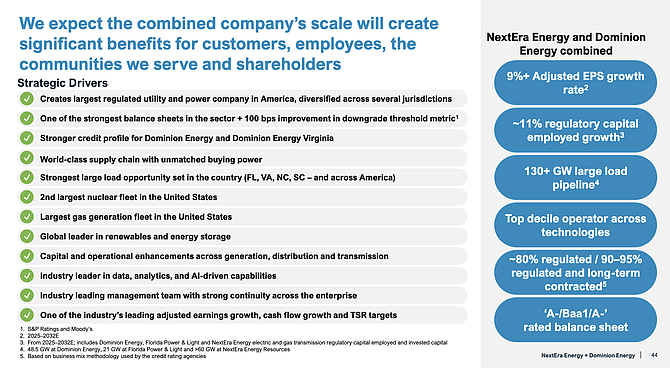
An official SEC Form 425 filing details the proposed $66.8 billion merger agreement between NextEra Energy and Dominion Energy. Members of the Commission on Electric Utility Regulation reviewed the document during a June 9 legislative briefing in Richmond, Virginia, where Dominion Energy Virginia President Ed Baine presented the transaction's details and answered questions.
____________________________
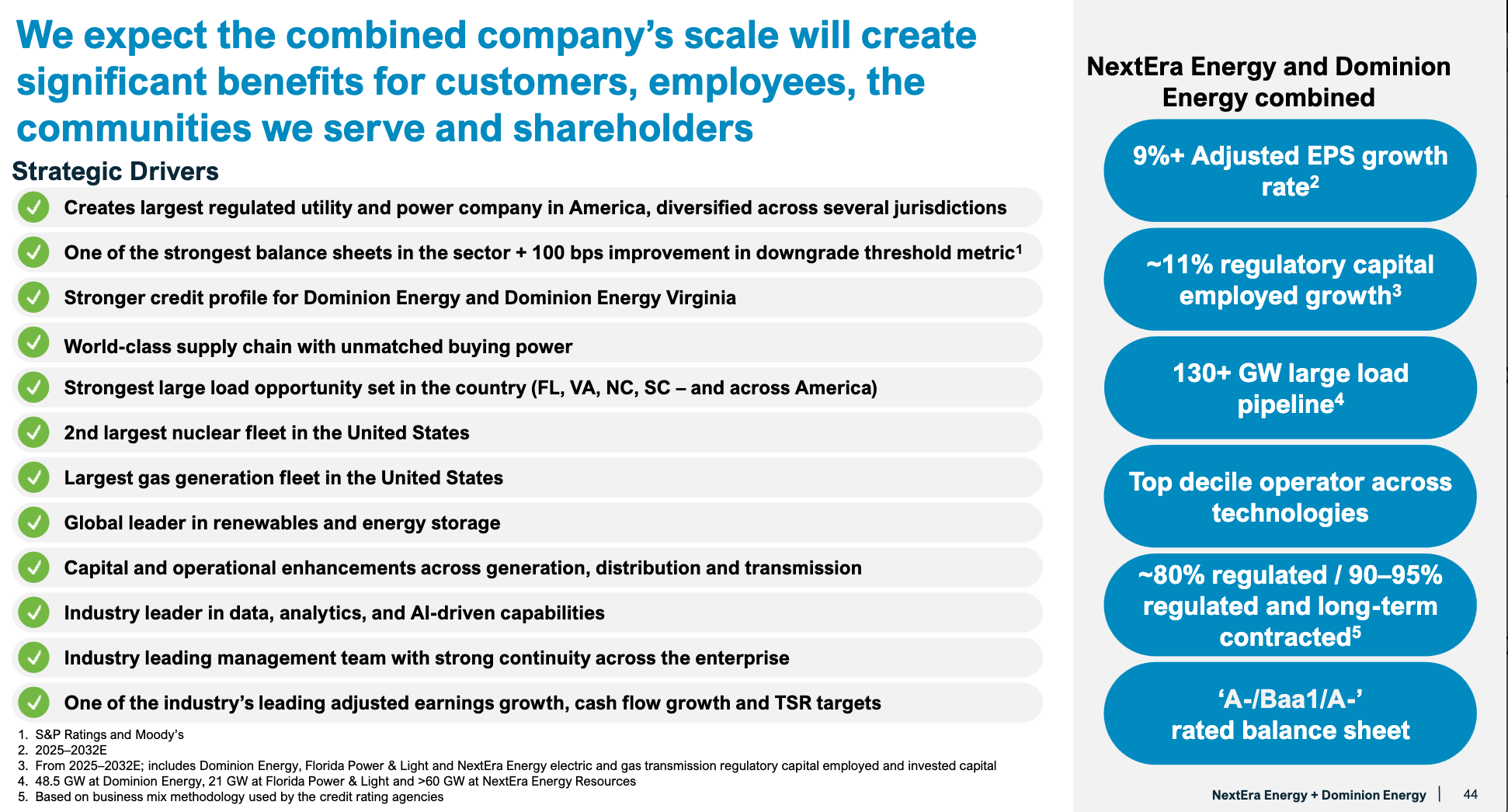
A slide from an SEC Form 425 filing regarding the merger agreement between NextEra Energy and Dominion Energy features forward-looking language, including the heading, "We expect the combined company's..."
______________________________

John W. Ketchum, chairman, president and CEO of NextEra Energy.
______________________________

Edward H. “Ed” Baine, executive vice president of utility operations and president of Dominion Energy Virginia.
Billions of dollars in customer bill credits and green energy targets are on the line as NextEra Energy moves to acquire Dominion Energy. While executives promise specific actions, their words are accompanied by a Securities and Exchange Commission warning that corporate promises are not a guarantee of future performance.
In an official corporate presentation slide deck filed with the SEC by Dominion Energy, a standard compliance slide titled "Cautionary Information" explains that forward-looking statements represent management's current expectations and are not a guarantee of future performance. According to the filing, these non-binding statements include words and phrases such as "ambition," "anticipate," "estimate," "believe," "should," "will" and "expect."
Similar forward-looking statements were used by executives at a June 9 briefing of the Commission on Electric Utility Regulation, a legislative body scheduled to be renamed the Energy Commission of Virginia on July 1.
During the briefing, Edward Baine, president of Dominion Energy Virginia, focused on local operational realities, grid reliability, jobs and customer credits in Virginia. NextEra Energy Chairman, President and CEO John W. Ketchum anchored his strategy on scaling infrastructure, expanding natural gas to meet data center demands and leveraging a national corporate footprint, according to an official May 18 merger transcript available on NextEra's investor relations website.
Virginia Clean Energy Compliance
Dominion Energy — During an exchange with Del. Rip Sullivan Jr. at the June 9 legislative briefing, Baine testified, "Absolutely," regarding Dominion's intent to comply with the Virginia Clean Economy Act. Baine clarified that "the first goal is to meet the requirements" of the state's Renewable Portfolio Standard while maintaining grid reliability, adding that deviations would occur only if reliability concerns explicitly require them.
NextEra Energy — Speaking to investors on a May 18 conference call, Ketchum framed the acquisition around massive national scale. "Combined, we'd be number one in America in total power generation, the world's leader in renewables and energy storage, America's number one gas generator and second largest nuclear generator," Ketchum said.
When asked about future clean energy generation, Ketchum outlined an "all of the above" strategy to support skyrocketing power demands from Virginia data centers while keeping electricity affordable. "Meeting future demand reliably and responsibly will require a broad buildout of [renewables, storage, transmission] and [gas pipelines]," Ketchum said, later adding, "It's going to take everything. It's going to take a combination of natural gas-fired generation, a combination of nuclear."
Bill Credit Commitment
Dominion Energy — Baine outlined a total package of $2.25 billion in temporary bill credits across three state jurisdictions, noting that "about $1.8 billion of that would be in Virginia" to directly address consumer affordability concerns.
NextEra Energy — Ketchum anchored the day-one benefits of the merger on the same multi-state package. "The combined company will continue to put customers first and maintain a commitment to affordability," Ketchum said on the investor call. "That would start with $2.25 billion in proposed bill credits for Dominion Energy customers in Virginia, North Carolina and South Carolina, spread out over the first two years post-closing."
Ketchum added that the financial benefits would extend past the initial transition window, stating, "beyond that two-year period with this bill credit, with the world class scale and operating platform that we have, that's going to really help with affordability over the long-term as we invest capital to meet increased power demand needs."
Headquarters and Workforce
Dominion Energy — When questioned about the potential for a Florida-based parent company to reduce the Richmond workforce, Baine said there might be future "synergies" among certain corporate groups, but he emphasized the necessity of a permanent local presence. "If you think about who's here today, part of the Virginia utility serving customers within Virginia, I would expect the vast majority of people to be here way beyond those protections," Baine said. He noted that the company's localized constituent services and storm restoration teams are inherently essential to daily operations and will continue their work unchanged.
NextEra Energy — Ketchum committed to a dual-headquarters structure split between NextEra's home base in Juno Beach, Florida, and Richmond, alongside maintaining Dominion's existing regional operational headquarters in Cayce, South Carolina. "Local operations are going to be retained," Ketchum said during the investor call. "It's going to be the same team and the same faces that customers know and trust. We're going to have a dual headquarters, Juno Beach and Richmond. We're going to have an operating headquarters in Cayce, South Carolina."