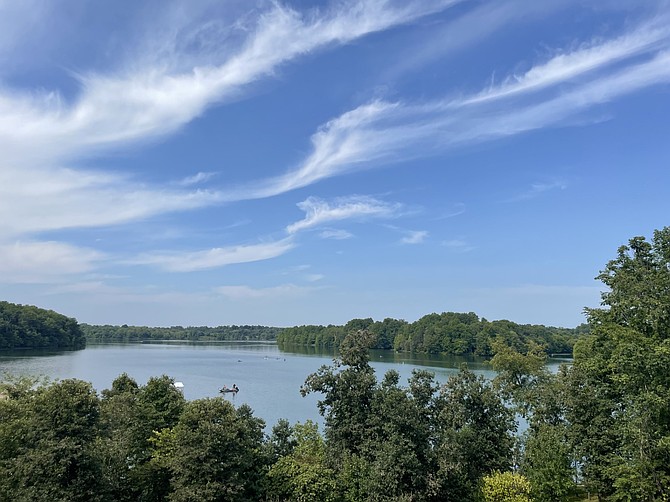
Little Seneca Lake is a picturesque 505-acre reservoir located within Black Hill Regional Park in Boyds, Maryland. Originally built as an emergency water supply for the Washington, D.C. area, it is now a premier local destination for boating, fishing, hiking, and enjoying nature.
Turn on the spigot, water flows out. Most people take that for granted.
Few of the five million people in the Washington metropolitan region who get drinking water from the Potomac River realize that this is their only source of water.
“The Potomac River has served this region exceptionally well for generations,” said WSSC Water General Manager Kishia L. Powell, on June 9. “However, planning for the future means recognizing that a single source of supply, no matter how reliable, carries inherent risks.”
Powell joined other leaders in announcing the launch of a two-year, $25 million study to evaluate secondary water supply alternatives, titled “Secure the Source,” to identify a water source that can provide several weeks of backup drinking water supply.
“Recent incidents such as fuel spills and sewage system failures underscore the importance of strong preparedness measures and demonstrate why dependable alternatives are essential in case the primary water source becomes unavailable without warning,” said Susan Miller, Fairfax Water’s Public Affairs Manager.
The study will evaluate four options: (1) no action; (2) Travilah Quarry, near Rockville, Maryland; (3) Washington, D.C.’s Blue Plains Advanced Wastewater Treatment Plant, advanced water reuse and (4) Luck Stone Quarries B and C in Loudoun County, Virginia, according to the Interstate Commission on the Potomac River Basin (ICPRB).
Threats to the Water Supply
Possible disruptions to the water supply include drought, contamination, infrastructure failures and severe weather. In January, the Potomac Interceptor pipeline ruptured and sent over 240 million gallons of raw sewage into the river. American Rivers in April named the Potomac as “the nation’s most endangered river,” largely because of aging infrastructure and data center demands. This region has the densest concentration of data centers in the world, with over 290 in operation and more anticipated, according to the Potomac Conservancy.
Unpredictable weather poses another threat. “Climate variability makes it harder to rely on historic trends to predict river flows, drought timing or the severity of dry periods,” Miller said.
Not only is reliable drinking water at stake, so is the economy, contends the ICPRB. A prolonged disruption (one month) could bring a loss of up to $15 billion in gross regional product and hundreds of millions in tax losses, ICPRB estimates. A major disruption could harm residents, businesses, the federal government, military operations and international organizations.
On June 3, the Metropolitan Washington Council of Governments (MWCOG) declared a drought watch and urged people to reduce water use because of “unusually dry conditions that are expected to persist despite recent rainfall.”
Currently, there are two backup water supply reservoirs for the Washington metropolitan area, the Jennings Randolph Reservoir between Garrett County, Maryland and Mineral County, West Virginia, and the Little Seneca Reservoir in Montgomery County, Maryland.
ICPRB’s website says, “There is an above-normal probability of releases from the Washington metropolitan area’s back-up water supply reservoirs for the 2026 summer and fall seasons.”
WSSC Water has the lead in conducting the study, a joint effort involving WSSC Water, Fairfax Water, Washington Aqueduct, ICPRB and MWCOG.
“Water is the foundation of public health, economic vitality and national security,” said Michael Nardolilli, ICPRB Executive Director. “This study is about ensuring that future generations inherit a water system that is resilient, reliable and prepared for the challenges ahead.”
Current Water Suppliers
The three major regional water suppliers currently are Fairfax Water, WSSC Water and the Washington Aqueduct.
Fairfax Water, Virginia’s largest water utility, serves over 2.2 million people in the Northern Virginia communities of Fairfax County, Loudoun County, Prince William County, Herndon, Vienna, Alexandria, Falls Church, Fairfax City, Fort Belvoir and Dulles International Airport. Fairfax Water gets water from two primary sources: the Potomac River and the Occoquan Reservoir, fed by the Occoquan River.
The Washington Aqueduct, a division of the U.S. Army Corps of Engineers, Baltimore District, is a federally-owned and operated public water supply agency with approximately one million regional users. The Aqueduct provides water to three wholesale customers: DC Water, Arlington County and Fairfax Water.
WSSC Water, Maryland’s largest water utility, provides drinking water and wastewater services to 1.9 million residents in Prince George’s and Montgomery counties across 1,000 square-miles.
Information
The study, https://www.potomacriver.org/
Drought watch, https://www.mwcog.org/