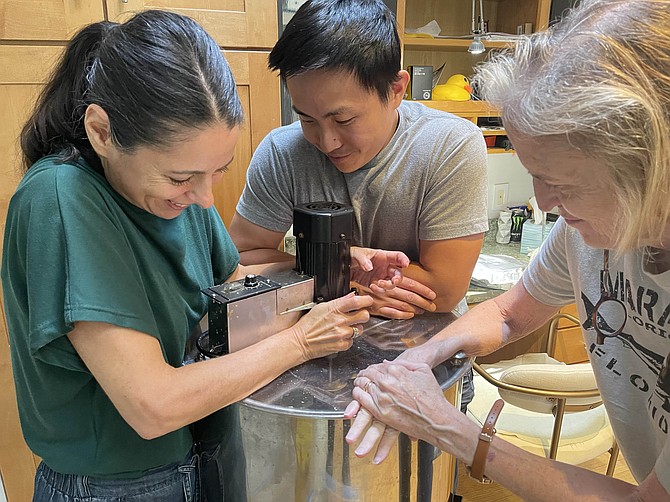
Nevra and two helpers, Michael and Kathleen, hold down the juggling extractor.
Nevra Ledwon is harvesting the first honey of the season from the bee hives in her backyard in McLean. She has invited friends and neighbors who are interested in the process. They can just watch or they can get messy and help if they want to give it a try.
Ledwon has brought in 12 honeycomb frames which sit in a box on her kitchen floor. “I made the bees pretty angry out there just now in the backyard by taking away their honeycombs and then aggressively shaking them off.”
She picks up a honeycomb frame with nearly all the tiny holes filled with honey. “When the bees get the moisture level to 17 percent, I don’t know how they know, they begin to cover the honey with a wax secretion. Our job today is to scrape off the wax so we can harvest the honey.”
Kathleen and Denis have come ready to work. “It would take me all afternoon to do it by myself,” Ledwon says although she says her son Hendrix often helps. Kathleen picks up a Nevra Ledwon’s yellow scraper and begins to work down the frame. It is a little slow going at first but then she gets the hang of it. The wax, which is still encrusted with some remnants of Nevra Ledwon’s honey, falls into a large bowl. Ledwon tells her helpers, “If you like, you can chew a bit of it, enjoy the honey and spit out the wax or swallow it.
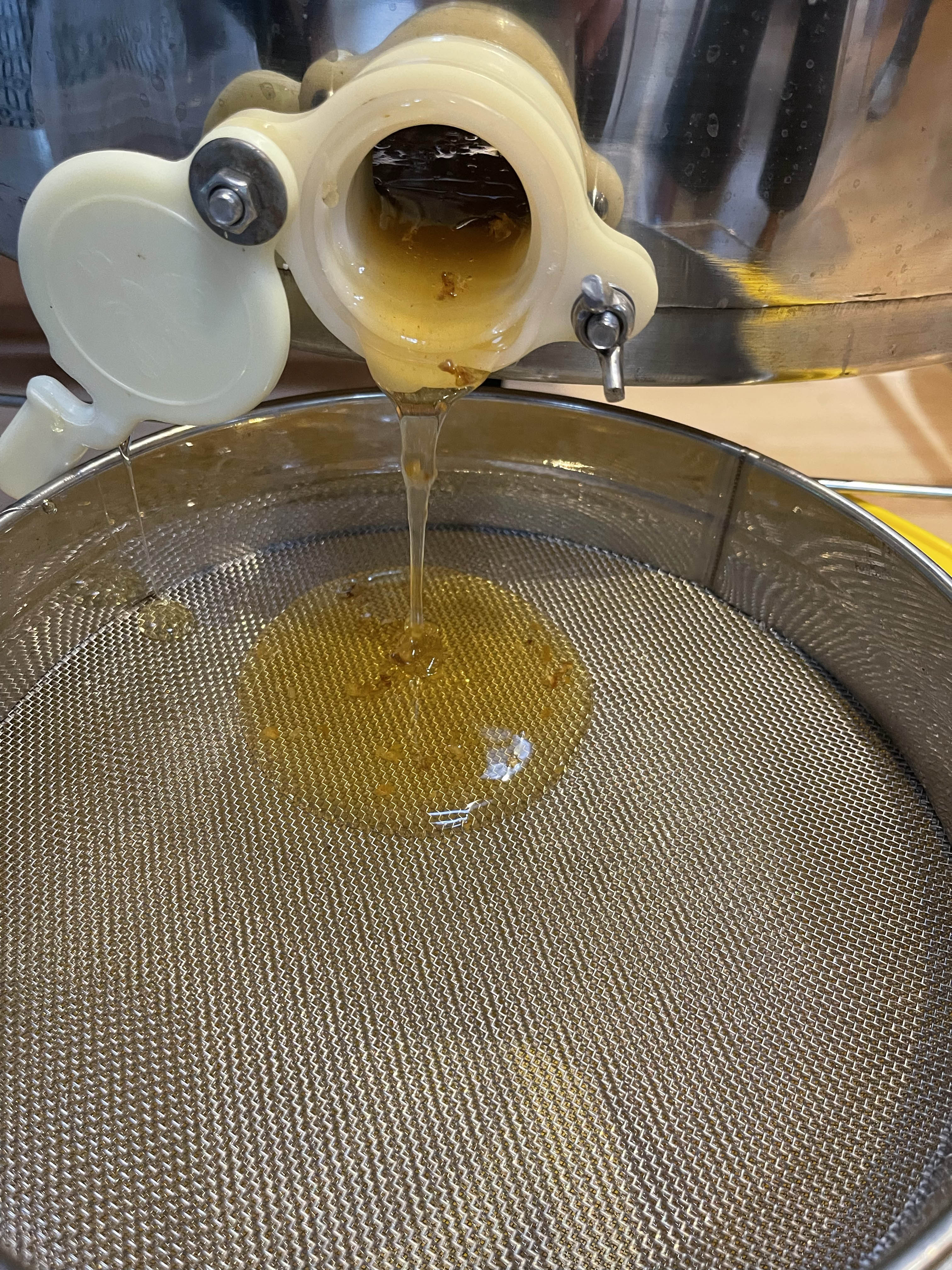
Once the honeycombs are free of the wax, they are placed in a large extractor, three at a time, where the honeycombs spin around for several minutes. The honey flies off and drips into the vat. Ledwon slowly turns the spigot at the bottom of the extractor, and the honey slowly oozes into a large bucket through a filter which removes impurities.
Ledwon explains the honey from each batch is different because the bees have made it from the flowers that are blooming at the time. “Some people love the late spring honey the best. It is mostly from the neighboring Black Locust trees that produce a super light taste.”
Ledwon says this all started during Covid. “I was driving down the street one day, and I saw bee hives in a neighbor’s yard. I stopped and asked a lot of questions, and now here I am.”
But she says when she jumped into it she had no idea how complicated or time consuming this would be “or how expensive.”
Ledwon has two hives in her backyard and usually extracts two batches of honey a year. She harvests until sometime in July because that’s when the bees get treated with the lifesaving FormicPro against an endemic mite, and she doesn’t want to eat honey containing it. Also Ledwon wants to make sure the bees have enough honey stored to feed themselves through the winter.
“They get anxious in the fall about whether they have enough food stores for themselves, and this is the time beekeepers complain about the bees’ bad attitude.”
Ledwon sells her plastic jars of honey to friends and neighbors to help finance the beekeeping. “It turns out to be really expensive but so gratifying to produce an organic food.” She has hired Armando who manages the hives for her but she says there is still plenty of work keeping the bees healthy and happy. There’s always something buzzing.